Cans vs Powders: The Format Decides the Price and the Honesty
Photograph: Adobe Stock, licensed 20 August 2026. Generic drink powder, not a product we rank.
The clearest split in this category is not brand against brand. It is format against format, and it decides two things before you have picked a flavour: what a serving costs, and how much you are told.
The numbers
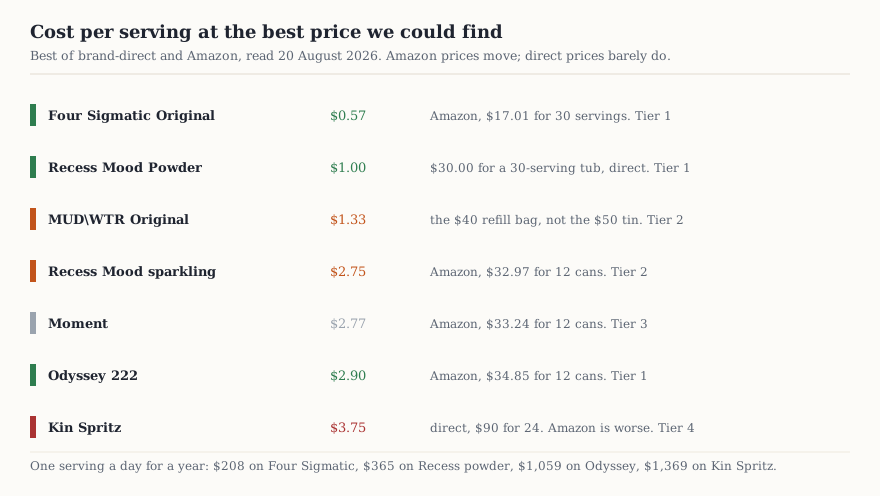
| Product | Format | Per serving | Disclosure tier | Caffeine |
|---|---|---|---|---|
| Four Sigmatic Original Mushroom Coffee | Powder | $0.57 | 1, per ingredient | 50 mg |
| Recess Mood Powder | Powder | $1.00 | 1, per ingredient | None |
| MUD\WTR Original | Powder | $1.33 | 2, blend total | 35 mg |
| Recess Mood | Can | $2.75 | 2, partial | None |
| Moment | Can | $2.77 | 3, names only | None |
| Odyssey 222 | Can | $2.90 | 1, per ingredient | 222 mg |
| Kin Spritz | Can | $3.75 | 4, proprietary blend | Undisclosed |
Powders win on price, and it is not close
57 cents against $2.75 to $3.75. Drink one a day for a year and that gap runs from about $790 at the narrow end to $1,160 at the wide end. You are paying for water, aluminium and a cold chain, which is a real cost and a real convenience, and it is worth knowing what it prices out at.
Even the most expensive powder here, MUD\WTR at $1.33, is less than half the cheapest can.
Powders also disclose more, and there is a reason
All three powders sit at tier 1 or 2. Three of the four cans sit at tier 2, 3 and 4. That is not coincidence.
A powder is sold as a supplement-shaped thing, to a buyer who expects a panel with amounts on it. A can is sold as a beverage, on a shelf next to other beverages, to a buyer who is choosing on flavour and design. Beverage buyers do not usually turn the can around, so beverage brands do not usually have to print the number.
Recess proves it inside a single brand. Its powder publishes 200 mg of L-theanine on the tub. Its can names L-theanine and gives no amount. Same company, same ingredient, different format, different level of disclosure.
Odyssey is the exception that shows the rule the other way: it publishes per-ingredient milligrams on a can, and it is also the can that positions itself as functional energy rather than as a lifestyle drink.
Where cans genuinely win
You will actually drink them. A tin of powder that needs hot water and a frother competes with your existing coffee routine. A cold can in the fridge competes with a beer, and wins more often than the tin does.
Cans travel. Nobody packs a frother.
The social occasion is a real product. Kin and Moment are not really selling adaptogens, they are selling something to hold at 8pm. That is a legitimate thing to buy and a powder cannot do it.
How we would actually split it
- The daily habit goes in a powder. That is where the price and the disclosure both live. Four Sigmatic at 57 cents if you want mushrooms and a coffee replacement, Recess Mood Powder at a dollar if you want a published L-theanine dose and no caffeine.
- Cans are the occasional purchase. Something for the evening, something to hand a guest, something for a flight. Buy those for what they are, not as a dosing strategy.
- Do not run both at full price. A can a day plus a powder a day is $100 to $145 a month for a category with this much unknown in it.